
In a previous post, we grumbled about definitions of social media that were too complicated or too vague. We were determined to do better.
We wanted a definition that effectively described the most fundamental elements of social media, and nothing more. After many heated, caffeine-fueled arguments, this is what we came up with.
Social media is:
Any set of equal nodes that can publish and subscribe to each other's information feeds.
It might sound rather technical, but it's not too complicated, we promise. Here's a diagram we put together that makes it a little easier to visualise:
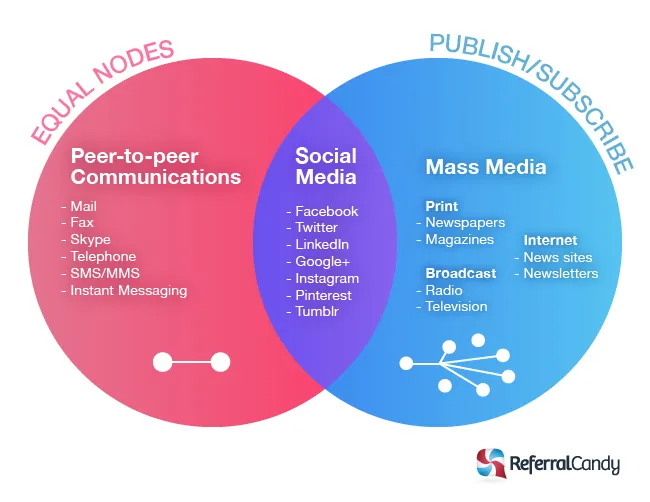
Shall we dig deeper? Let's begin by analysing each of the components separately.
1: What's a node?
Most simply, a node is a point in a network.
- Every network has a set of characteristic data types. The data being transmitted through the network defines the network. In the postal system, it's mail. On Twitter, it's tweets. On YouTube, it's videos and comments.
- A node is any entity that can send or receive these data types. A Twitter account is a node in the Twitter network because it can send and receive Tweets.
- A node doesn't have to be a specific individual. It simply needs to be able to send or receive information. A radio station is a node because it can transmit information, even though it's not a single individual.
2: What do equal nodes mean?
- Equal nodes have the same capacity for transmitting and receiving information. For instance, every telephone set in a telephone network can make and receive calls, just like every other telephone set in the network. In contrast, a network of unequal nodes (such as a TV network) has nodes with different capacities to transmit and receive information. The TV station can transmit information to the TV sets, but TV sets cannot communicate with each other, or with the station.
- Equal in capacity does not mean equal in influence. One Twitter account may have millions of followers and another might have none, yet they both have equal capacity to transmit and receive information.
3: What does 'publish' mean?
Traditionally, publishing meant "to announce, to declare, to make public." This still applies here.
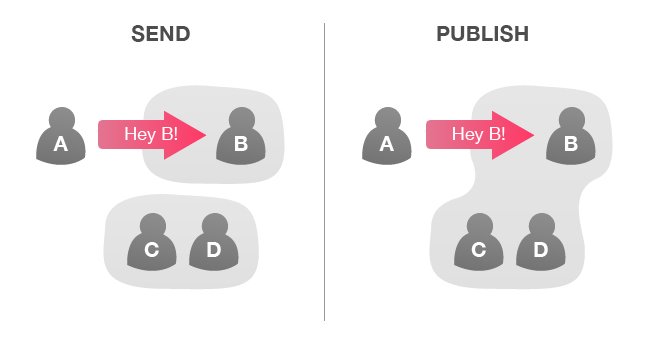
- A message is published when it is made accessible to nodes that aren't addressed in the message. In the diagram above, A addresses his message to B, but it's accessible to C and D as well.
- The nature of publishing allows for messages without specified addressees. A telephone system doesn't allow you to make a phone call to "anybody who might be interested." Publishing does. This has some very interesting implications on social dynamics, which we'll explore in our next post.
4: What about 'subscribe'?
- Subscription is when a node elects to receive updates from another node. If you subscribe to a magazine, you'll periodically receive the magazine in the mail for as long as the magazine is in business, and the postal service is in working order. (Until you unsubscribe.)
- In Twitter, for example, subscription is just a matter of clicking a Follow button. Tweets from the user you just followed will then start appearing in your feed, without them specifically addressing you. Simple!
5: Okay. So how do you tell if something should be considered Social Media or not?
First, observe the system you want to analyse.
- Identify its characteristic data types. What's the stuff that's being sent around? Videos? Pictures? Tweets?
- Identify the set of nodes. Who or what is sending and receiving the data?
- Of these, identify nodes that have the capacity to publish as well as the capacity to subscribe. (If a node can publish to A and subscribe to B, it stays.)
- Of these, is there a subset of equal nodes? Is there a subset of nodes in which all nodes have the same capacity to publish and subscribe as every other node in the subset?
This might get a little tedious, so we took the trouble of doing some analysis for you:
1: Characteristic data types2: Set of nodes3: Nodes that can publish AND subscribe4: Is there a subset of equal nodes?Is It Social Media?Postal MailMailSender, RecipientNone. All mail is addressed directly to recipient. No publishing or subscription involved.N/ANo.SMSSMSPhonesNone. All SMSes are addressed directly to recipient. No publishing or subscription involved.N/ANo.PhonePhone CallsPhonesNone. All phone calls are made directly to recipients. No publishing or subscription involved.N/ANo.Company NewslettersNewsletterCompany, CustomersNone. Company cannot subscribe to customers. Customers cannot publish newsletters.N/ANo.WikipediaArticles, Talk pagesWikipedians, Wikipedia pagesWikipedians automatically publish a feed of their edits, and can subscribe to Wikipedia pages. Wikipedia pages cannot subscribe to any nodes.No, Wikipedians cannot subscribe to each other.No.NewspapersNewspapersNews Organization, ReadersNone. News Organizations cannot subscribe to readers. Readers cannot publish newspapers.N/ANo.FM RadioRadio showsRadio Stations, Radio SetsNone. Radio stations cannot subscribe to radio sets. Radio sets cannot publish radio shows.N/ANo.TelevisionTV showsBroadcast Stations, TV SetsNone. TV stations cannot subscribe to TV sets. TV sets cannot publish television shows.N/ANo.WhatsAppChat message (includes text, images, audio)Whatsapp Users, Group ChatsWhatsApp users can subscribe and publish to group chats. Group chat cannot subscribe to any other nodes.No, WhatsApp users cannot subscribe to each other.No.WarriorForumForum Posts on WarriorForum (WF)WF Users, Forum ThreadsWF Users can publish posts and subscribe to threads. Forum threads cannot subscribe to any other nodes.No, WarriorForum Users cannot subscribe to one another's feeds.No.Stack OverflowStack Overflow (SO) questions, answers, commentsSO Users, question threadsSO Users can subscribe to question threads, and can publish answers. Question threads cannot subscribe to any other nodes.No, Stack Overflow Users cannot subscribe to one another's feeds.No.LiveJournalBlogposts, CommentsLiveJournal UsersLiveJournal users can publish and subscribe to other LiveJournal users.Yes, LiveJournal users.Yes!TwitterTweetsTwitter ProfilesTwitter users can publish and subscribe to other Twitter users.Yes, Twitter users.Yes!TumblrTumblr Posts (Text, Audio, Images, Video)Tumblr UsersTumblr users can publish and subscribe to one another.Yes, Tumblr users.Yes!PinterestPicturesPinterest UsersPinterest users can publish and subscribe to one another.Yes, Pinterest users.Yes!FacebookFacebook Posts (Text, Image, Video), commentsUsers, Pages, GroupsUsers, Pages and Groups all publish information. Pages can subscribe to other Pages, but not to Users or Groups. Groups cannot subscribe to any other node.Yes. Facebook Users can subscribe to each other's feeds by "Add Friend" or "Follow". Facebook Pages can also subscribe to each other's Feeds by "Liking" each other. However, they cannot subscribe to individual Facebook Users.Yes!Google+G+ Posts (Text, Images, Video)Users, Pages, GroupsUsers, Pages and Groups all publish information.Yes. G+ Users can subscribe to each other's feeds by "Adding To Circles".Yes!LinkedInLinkedIn PostsUsers, Pages, GroupsUsers, Pages and Groups all publish information.Yes. LinkedIn Users can subscribe to each other by "connecting".Yes!InstagramPhotosInstagrammersInstagram users publish photos, and can subscribe to one another by "Following."Yes, Instagrammers.Yes!SpotifyMusic PlaylistsSpotify UsersSpotify users can publish playlists and subscribe to each other's playlists.Yes, Spotify users.Yes!YouTubeVideosYouTubersYouTubers can publish videos to their channelsYes, YouTubers.Yes!QuoraQuestions, answers, commentsQuorans, question threadsQuestion threads cannot subscribe to one another, or to Quorans. Quorans can publish and subscribe to one another's feeds.Yes, Quorans.Yes!RedditSubmissions, CommentsRedditors, SubredditsSubreddits cannot subscribe to one another, or to Redditors. Redditors can publish to subreddits, and subscribe to both subreddits and other Redditors. Notably, every Redditor has their own feed.Yes. Redditors can subscribe to one another's feeds (+Friend).Yes!WordpressBlogposts, CommentsWordpress Users, Anonymous CommentersCommenters cannot publish their own blogs on the Wordpress platform unless they become Users. Wordpress Users can publish and subscribe to one another's blogs.Yes, Wordpress users.Yes!
That's all for now, but more to come!
We went down this rabbit-hole in pursuit of the answer to "What Is Social Media?", but we believe that we've also stumbled upon answers to "Why does social media matter?" and "What are the consequences of social media?", and even "Why are so many people annoying on social media?"
We're going to have a lot of fun exploring those questions.
We hope you find this framework useful in navigating and thinking about social media! Let us know if you have any thoughts, questions, ideas, corrections or suggestions.
EDIT: A few people have asked us if they can use our image for their slideshows, presentations, etc. Go right ahead! We'd love you if you leave the ReferralCandy logo in, and linked to this post or credited us in someway, but otherwise we're really happy that people like our definition enough to use it. :-)
Other posts in this sequence:
- What IS social media?
- Why is it so hard to define social media, and why should we care?
- What's the difference between 'social networking sites' and social media?
- Why are people so annoying on social media?
- How did online social networks disrupt traditional media?
- How will social media change the way we live and consume?