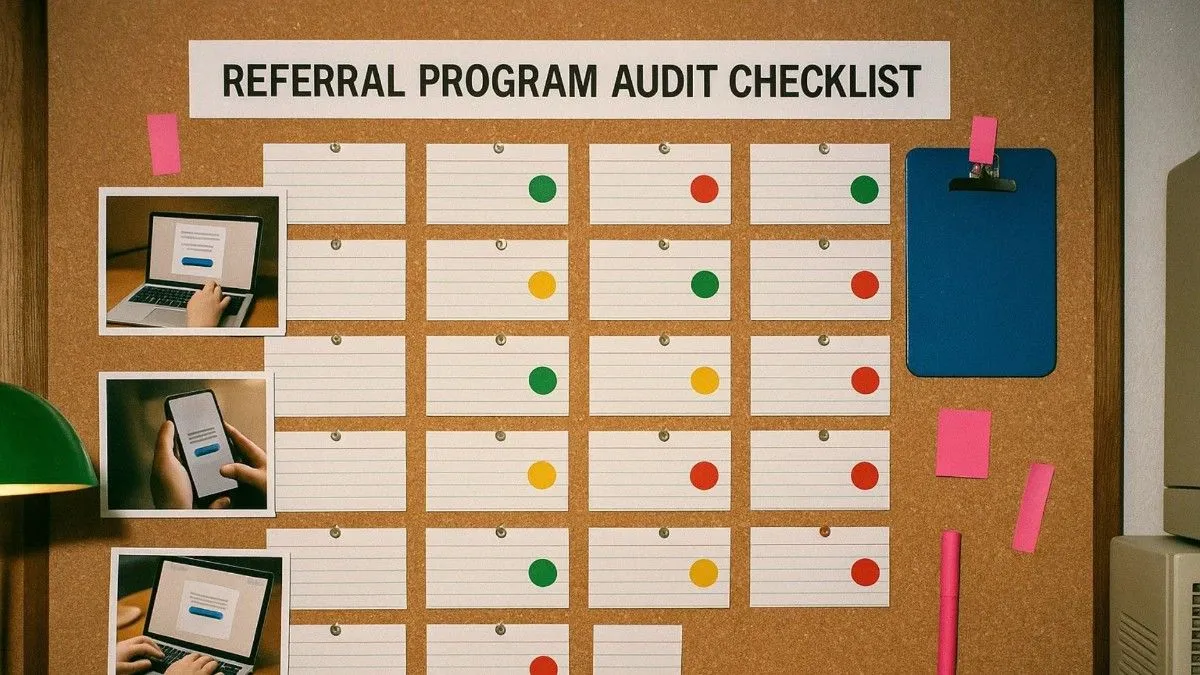
Quick answer: Use this 30-point affiliate program audit checklist to fix tracking, payouts, partner quality, and growth levers in one focused review.
Table of Contents
- Why an affiliate program audit matters
- Tracking and attribution checks
- Commission, rewards, and payouts
- Partner quality and compliance
- Offer, pages, and conversion
- Promotion and visibility levers
- Analytics, reporting, and forecasting
- Launch / Optimise Checklist
- FAQ
- Takeaways
Why an affiliate program audit matters
A short, structured audit prevents wasted spend and missed revenue. Benchmarks help you see what “good” looks like and where to act first. For example, 2026 referral conversion medians sit around 3 to 5 percent, with top programs above 8 percent. Use that as a north star when judging landing pages and offers.
Tracking and attribution checks
Goal: validate that every qualified order is credited correctly and visible in reports.
- Confirm link and code tracking fires on both desktop and mobile. Test one order per top partner.
- Verify attribution window matches buying cycle, typically 7 to 30 days for DTC.
- Check coupon-only orders still attribute correctly when shoppers enter at checkout.
Validate cross-device conversions where your audience is mobile-first.
Compare platform numbers to store orders for the last 30 days. Investigate gaps over 5 percent. - Tag test orders as “QA” to avoid paid commissions.
- Review UTM conventions in partner assets and your <a href="https://www.referralcandy.com/affiliate-marketing">affiliate marketing</a> playbooks.
- If you run referrals alongside affiliates, confirm the systems don’t double-credit the same order. A combined dashboard helps here.
Commission, rewards, and payouts
Goal: protect margin while staying attractive to creators and publishers.
- Map commission by partner type. Consider higher rates for content partners that drive new customers.
- Audit “new-customer only” rules if that is your policy.
- Sanity-check effective CAC. Compare affiliate CAC to paid social and paid search.
- Review flat-fee vs percent of sale. Adjust to protect low-margin SKUs.
- Sample 10 recent payouts and re-calculate by hand. Correct any drift before the next cycle.
- Confirm your payout cadence and methods fit partner needs, especially for multi-currency stores. ReferralCandy supports multi-currency cash or store credit so partners get paid in their preferred currency without extra ops work.
Partner quality and compliance
Goal: prune low-value traffic, reward high-value creators, and prevent abuse.
- Segment partners by type: creators, review blogs, coupon sites, communities. Judge each on different baselines.
- Rank partners by earnings per click, not clicks alone.
- Compare affiliate AOV and refund rate versus site-wide averages.
- Review content freshness for top 20 partners. Outdated codes hurt conversion and trust.
- Scan for coupon leakage and self-referrals. Enable leaked-code detection and IP checks. ReferralCandy flags suspicious use so you can block abuse early.
- Review application forms and approval flow. Collect what you need to evaluate quality without friction.
Offer, pages, and conversion
Goal: raise conversion from referred traffic by tuning the shopper experience.
- Test the friend-side offer. Double-sided incentives often boost click-through and purchases. Benchmarks show better results when redemption is friction-free and rewards feel cash-equivalent.
- Load-test the landing page on mobile. Every second of delay can hurt conversion.
- Auto-apply discount on landing or at checkout to remove code friction.
- Add social proof near the CTA. Review stars and a short testimonial from a similar customer segment work well.
- For Shopify, confirm product or SKU exclusions are set on low-margin items so codes don’t over-discount.
Promotion and visibility levers
Goal: more qualified clicks by placing affiliate and referral CTAs where customers already are.
- Add post-purchase popups and account-page widgets to activate customers who love your brand. Share rate rises when you add more touchpoints across email and site.
- Refresh your creator media kit. Provide logo files, short blurbs, and fresh product images.
- Build quarterly campaigns with seasonal hooks. Provide pre-approved copy blocks and short links to partners.
- Keep a living list of your top 20 affiliates and send them early access or bundle offers before major events.
- If you need a tool check, review the <a href="https://www.referralcandy.com/blog/7-best-shopify-referral-apps-to-grow-your-store-in-2025">best Shopify referral apps</a> explainer for ideas on must-have features like A/B testing, fraud filters, and widgets that actually get used.
Analytics, reporting, and forecasting
Goal: move from reactive payouts to proactive growth.
- Track the core seven KPIs weekly: conversion rate, EPC, AOV, commission outlay, affiliate CAC, revenue by affiliate, and refund rate.
- Add advanced metrics as you scale, like LTV of affiliate customers and time to first conversion. This reveals which partners drive durable value.
- Benchmark your numbers against current medians. If you sit below peers, start with reward relevance and redemption friction before changing creatives.
- Document one hypothesis to test every 30 days, for example, increasing the friend offer by 5 dollars on mobile traffic only.
- Pipe data into your BI tool and keep a monthly “top movers” note for partners and offers.
Launch / Optimise Checklist
- Confirm links, codes, and attribution windows with one end-to-end test order
- Segment partners and set tiered commissions by type
- Lock fraud rules and leaked-code detection before next payout
- Refresh the landing page with auto-applied discounts and visible social proof
- Activate post-purchase popup and account-page widget
- Email your top 20 partners with the next campaign brief
- Add one A/B test to the offer or the page every 30 days
- Compare affiliate CAC to paid social and search last month
- Publish or update your public “Affiliates” page with a clear application form
- If you want referrals and affiliates together, turn on ReferralCandy so you run both in one place, then invite creators through the same branded portal.
An audit is most valuable when benchmarked against what partner-driven growth through affiliate marketing looks like at its best — use that standard to identify the gaps in your current program.
Recommended tool: how ReferralCandy helps you fix audit gaps
- Unified tracking, referrals + affiliates: See orders, codes, and partner performance in one dashboard, so QA is faster and payouts are accurate.
- Fraud protection built-in: Flag self-referrals and leaked codes before they drain margin.
- Activation widgets that get used: Post-purchase popups and embedded account widgets lift shares and clicks without custom development.
- Flexible payouts: Pay cash or store credit, including multi-currency, on the cadence your partners expect.
If you are starting from scratch, this <a href="https://www.referralcandy.com/blog/referral-program-template">referral program template</a> covers onboarding emails, landing copy, and the assets that creators need on day one. You can also review practical features in this roundup of <a href="https://www.referralcandy.com/blog/best-shopify-affiliate-apps-for-influencers-referrals-in-2026">affiliate tracking apps</a> to see how ReferralCandy compares across fraud rules and widgets.
For a deeper how-to, the Shopify setup guide explains how to install an app, set rules, and recruit partners in under an hour, which is useful after your audit leads to a relaunch.
FAQ
How often should I run an affiliate program health check?
Monthly is a good rhythm for growing brands, with a deeper quarterly review before big seasons. The monthly pass should include a reconciliation of commissions, a scan for coupon leakage or self-referrals, and a check of your top partners’ content freshness. When in doubt, compare affiliate CAC to paid channels so spend flows to the best ROI.
What benchmarks should I use to judge conversion?
For referral and affiliate traffic, a 3 to 5 percent conversion rate is a reasonable median target in 2025, with top performers above 8 percent. If you are below that, address reward relevance and redemption friction before rewriting content. Auto-applied discounts and clear social proof are common quick wins that lift results without a full redesign.
How do I handle low-quality but high-volume affiliates?
Segment these partners and model margin impact, not just revenue. If EPC and refund rate are weak, switch to new-customer-only rules or lower rates on coupon traffic while keeping higher tiers for creators and review sites. Track changes for a full pay cycle before making more cuts, and communicate clearly so good partners stay engaged.
Can I manage referrals and affiliates together without extra tools?
Yes. With ReferralCandy you can run both programs in one place, activate customers automatically after checkout, issue codes and links, detect fraud, and pay in cash or store credit. This reduces setup work and makes audits easier because all core reports live in one dashboard, from shares to conversions to payouts.
Takeaways
- Audit tracking first, then payouts, then partner quality, then conversion.
- Use benchmarks to focus your effort and set realistic goals.
- Visibility drives growth, so add on-site and post-purchase touchpoints that customers actually see.
- ReferralCandy covers the common gaps uncovered by this audit and helps you act on them fast.
Once your audit is complete, explore ReferralCandy plans and pricing options to see if the platform gives you the features and reporting tools your program needs to improve.